Operator Training and Commissioning for a New Brewery
Commissioning is the fortnight that decides whether a new brewery starts earning in its first month or its third. HGMC publishes four services that cover that period: equipment installation, commissioning, operator training, and maintenance support with spare parts supply. The work starts earlier than most buyers expect, because the free design stage happens before the vessels are built and the operator hours land in the first month of production.
Key takeaways
- The published service list covers installation, commissioning, operator training, and maintenance support with spare parts supply.
- HGMC provides 2D, 2.5D and 3D design free of charge, covering brewery space layout and brewhouse vessel and piping design, before anything is manufactured.
- Control level shapes the training: a PID display panel, a PLC semi-automatic touch screen, or a PLC fully automatic panel with curve indication and production-record printing.
- Delivery is published at 90 to 150 days from deposit to door, so training and commissioning have to be booked against the delivery date, not the order date.
What commissioning actually consists of
A brewery does not simply switch on. Commissioning is the sequence of checks that proves each circuit does what the drawing says: pressure tests on vessels and jackets, leak checks on the whole assembly, pump direction and flow, cooling performance against the design duty, and a first brew that is watched end to end rather than merely attempted. The published service list for HGMC puts equipment installation and commissioning first, which is the honest order, because a brewery that is installed by the supplier and commissioned by the buyer's electrician tends to find its faults slowly.
Operator training comes next and is usually delivered as part of the same visit. Training on a new plant is not a lecture about brewing; the operators already know how to brew. It is a working session on this panel, this valve sequence, this cleaning routine and this record sheet, repeated until the shift can run a brew without a telephone call. HGMC publishes operator training explicitly as one of the services, alongside maintenance support and spare parts supply.
The design service that starts before delivery
The most useful part of the handover happens months earlier. HGMC provides 2D, 2.5D and 3D design free of charge, covering brewery space layout and the brewhouse vessel and piping design in 3D models. For a new building that is the difference between discovering that a manway cannot open against a wall on a drawing and discovering it on the day the tank lands.
Use the design stage to answer the questions that commissioning would otherwise expose: where each vessel is approached from, how a spent grain route works, where the cleaning circuit runs, how a panel is reached for maintenance, and how the replacement of a pump or a valve is physically possible. A plant that is convenient for a fitter is a plant that recovers faster from a fault.
| Phase | What the manufacturer provides | What the brewery must have ready |
|---|---|---|
| Design | Free 2D, 2.5D and 3D layout, vessel and piping design | Building dimensions, utility data, intended brew method |
| Installation | Equipment installation on site | Access, lifting, water, power and drainage in place |
| Commissioning | Pressure and leak checks, first brews with the engineering team | Ingredients, vessels clean, cellar ready to receive wort |
| Training | Operator training on the installed control level | Named operators released from other duties |
| Handover | Maintenance support and spare parts supply | A spares list and a named person to hold it |
Training changes with the control level
The published control options run from a PID display control panel, through a PLC semi-automatic touch screen, to a PLC fully automatic control panel with curve indication and production-record printing. Each one asks for a different training conversation. On a PID panel the operators learn the sequence themselves and the training is about doing it the same way twice. On a semi-automatic touch screen the panel holds the sequence and the training is about knowing when to intervene. On the fully automatic level the training shifts to reading curves and production records, which is a different skill from turning valves.
Match the control level to the team. A fully automatic panel on a plant with one brewer and no maintenance cover can be more equipment than the site can use, while a PID panel on a plant running three shifts leaves every shift free to invent its own method. The published quality system is in compliance with ISO9001:2015 and products are exported to more than 120 countries, which is a reason to expect the documentation to be as standardised as the panel.
Spares, maintenance and the first month
The last item on the published service list is spare parts supply, and it is the one that decides how long a brewery is stopped when something fails. Build the spares list during commissioning, not after the first breakdown: the parts that stop production are known before the plant starts, and the published 6-year warranty on tank accessories and electronic components against manufacturing defects from the factory, used within scope, is easier to use when the serial numbers and plates are already filed.
Maintenance support is the second half of that cover, and it works best on a schedule. A short monthly walk round of cooling circuits, controllers and cleaning equipment costs a morning a month and finds most of the problems that would otherwise appear in the middle of a fermentation.
Worked example
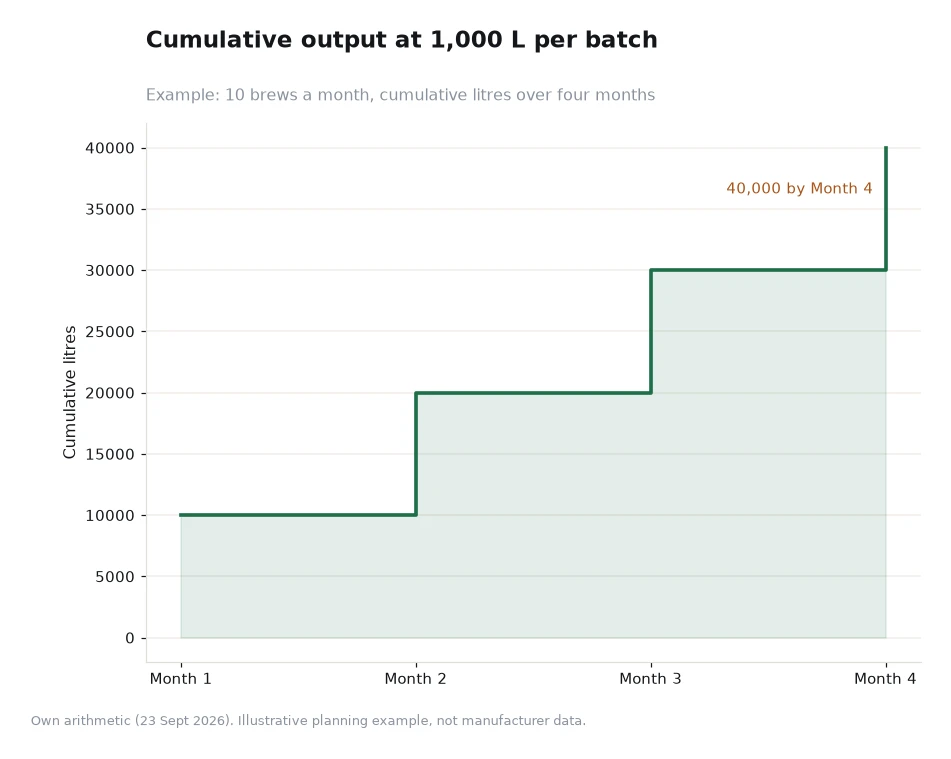
Worked example, with the assumptions written out. Take a 1,000 L brewhouse, 10 brews a month, and the four-month commissioning ramp plotted in the chart below: 10,000 L after month one, 20,000 L after month two, 30,000 L after month three and 40,000 L after month four. Convert the total with the published conversion of 1 BBL at about 117 L: 40,000 divided by 117 is roughly 342 BBL.
Now add the training load to the same plan, labelled as my own estimate. Assume three operators given five working days of training at 8 hours each, which is 120 operator hours, and assume 9 operator hours per brew in the first month across the same three people. Ten brews at 9 hours is 90 hours, so the first month asks for 120 plus 90, or 210 operator hours. Across four working weeks that is about 52 hours a week between three people, which is roughly one third of each person's week.
That is the number to put against the commissioning date. If the training week is scheduled before the tanks are installed, or in the same week as the first brew, the hours do not fit. The published delivery window of 90 to 150 days from deposit to door is long enough to plan the visit properly, and the three-hour arithmetic above is a labelled example rather than manufacturer data.
Frequently asked questions
What is included in commissioning and training?
HGMC publishes equipment installation, commissioning and operator training as services, supported afterwards by maintenance support and spare parts supply, with a free 2D, 2.5D and 3D design stage covering brewery layout and brewhouse vessel and piping design before manufacture.
How should training be timed against delivery?
Against the published window of 90 to 150 days from deposit to door delivery, rather than against the order date, because commissioning follows delivery and the first brew is the point at which trained operators and an untrained shift diverge most sharply.
Booking the handover properly
Put the design stage, the installation visit, the training week and the spares list into one project plan with named owners, then hold the supplier to it. The free design service is described with the manufacturer's hgmc brew system range, and the brewery systems section shows which items arrive together. Vessel-by-vessel piping and layout drawings sit under the brewhouse equipment pages, and the training content follows the control level ordered, from a PID display panel through a semi-automatic touch screen to a fully automatic panel with production-record printing.
Services and specifications described here come from the manufacturer's own website, read 23 Sept 2026: equipment installation, commissioning, operator training, maintenance support and spare parts supply; the free 2D, 2.5D and 3D design service; the three control levels including production-record printing; the 6-year warranty on tank accessories and electronic components against manufacturing defects from the factory used within scope; the ISO9001:2015 quality system; and the 90 to 150 day delivery window from deposit to door.[1] The operator-hour figures are a labelled example by this page.