Documents and Compliance in a Gift or Travel Set Order
Compliance work does not sit after production; it constrains the pack, the artwork and sometimes the formula. A gift or travel set multiplies that constraint, because each SKU in the set may need its own documentation while the outer pack has to carry a combined label. Planning the documents at the same time as the order quantity is what prevents a run being printed with the wrong information.
Key takeaways
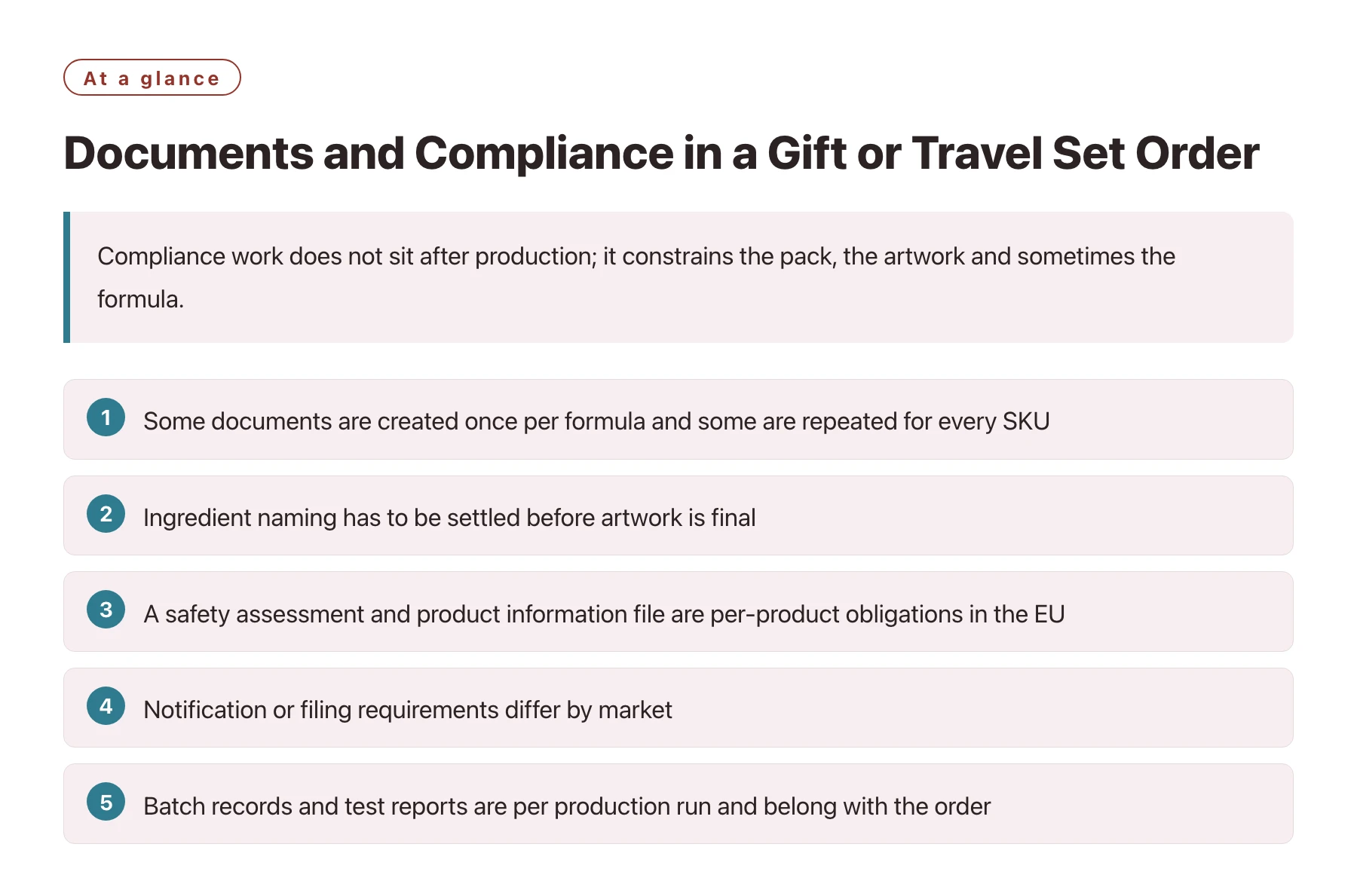
- Some documents are created once per formula and some are repeated for every SKU, which means the number of variants in a set changes the compliance workload.
- Ingredient naming has to be settled before artwork is final, because the label and the regulatory file use the same standard nomenclature.
- A safety assessment and product information file are per-product obligations in the EU, and they follow the product rather than the size of the brand.
- Notification or filing requirements differ by market, so the destination list has to be known before the first label is printed.
- Batch records and test reports are per production run and belong with the order, not in a folder that arrives later.
Buyers tend to think of documentation as an administrative tail on a production project. In practice it is one of the inputs: the label has a fixed amount of space, the declaration list depends on the formula, and the market determines what must appear on the pack at all.
A set makes this harder in a specific way. A box containing three 10 ml sprays is one product for the customer but three formulas for the regulator, and the outer packaging may need to carry information for all of them.
What follows is the document list that a set project usually needs, with the point at which each item has to exist. It is a planning aid rather than legal advice; the requirements that apply to a specific product in a specific market still have to be assessed for that product.
The distinction that determines the workload
Every document in a fragrance project belongs to one of two categories: per formula, or per order. Getting that distinction right early tells a buyer how the documentation cost behaves as the set grows.
Per-formula items — the safety assessment, the ingredient declaration, the specification and the stability work — are repeated for each distinct scent or product type in the set. Per-order items — the batch record, the certificate of analysis, the packing list — are repeated for each production run regardless of how many variants it contains.
This is why a set of three variants that share one bottle, one box and one carton is cheaper to document than a set of three variants in different formats. The packaging tooling is one saving; the documentation is another.
It is also worth seeing how a candidate manufacturer describes its own documentation scope. The service pages at www.xuelei.com set out one company's scope, and any such description is only useful as something to test against a written document list.
The items with the earliest deadline
Ingredient names are the least glamorous item on the list and the one that most often delays a print run. Labels use a standard nomenclature, and the EU's CosIng database is the reference list most export markets align with for ingredient names and their declared functions [1]. If the formula is still moving while the artwork is being finalised, the declaration can change after the plate has been made.
Where responsibility sits
For cosmetics placed on the EU market, a responsible person established in the Union has to be designated, and the product information file and labelling obligations attach to the product rather than to the size of the company behind it [2]. A small brand and a large manufacturer face the same requirement, though the work may be divided differently between them.
That division is worth writing down. Manufacturers normally supply the technical content — formula details, batch records, test reports — while the brand or its representative assembles the file and owns the declarations. When that split is unclear, both sides assume the other has done it.
The documents a set order usually needs
| Document or step | Who issues it | When it has to exist |
|---|---|---|
| Product specification | Brand and manufacturer jointly | Before sampling, and updated when the pack changes |
| Ingredient declaration (standard names) | Formulator, reviewed against the ingredient reference list | Before artwork is final |
| Safety assessment | A qualified safety assessor | Before the product is placed on the EU market |
| Product information file | The responsible person | Before market placement, and kept available to authorities |
| Label artwork with mandatory content | Brand, with a regulatory review | Before the print run, not after |
| Cosmetic notification or filing | Responsible person or importer, depending on the market | Before or shortly after first sale, depending on the market |
| Batch record and certificate of analysis | Manufacturer | With each production run |
| Stability and pack compatibility reports | Third-party laboratory or the manufacturer's own laboratory | Before release, and retained for the product's life |
| Safety data sheet for the concentrate | Fragrance house or formulator | Before transport and handling |
The first five items are per formula or per product; the last four belong to the order. When a supplier quotes documentation as a single line, ask which items that line covers.
Market differences that affect the pack, not just the file
It is tempting to design one pack and adapt the paperwork. Some requirements do not work that way, because they change what must be printed.
In Canada, cosmetic products have to be notified to Health Canada, and labelling has to meet the requirements set out in the cosmetics regulations, including ingredient disclosure in the required form [3]. A pack designed for one market may not have room for what another market requires, and the outer box of a set is often the only surface large enough to carry it.
The practical approach is to make a list of every market the set will be sold in, then design the label around the strictest combination. That usually means more space reserved for text than the first draft allows, which is far easier to accommodate before the box die is cut.
What the manufacturer can and cannot provide
A factory that exports regularly will have a standard document pack for the markets it serves most often, and that pack is a reasonable indicator of experience. It is not confirmation that a particular product is compliant in a particular market; that assessment is made for the finished formula and the finished pack, and it is normally the brand's obligation or that of its appointed representative.
Why this belongs in the MOQ conversation
Documentation is one of the fixed cost lines, and it is one of the few that grows with the number of variants rather than the number of units. A buyer deciding how many SKUs to include in a set is also deciding how much compliance work to commission. That is a design decision with a cost attached, and it should be taken with the number visible.
It also interacts with the schedule. The slower of the two workstreams — components or documents — sets the delivery date, which is why the way a factory discusses production capacity and lead times is a useful signal of whether it manages both together or treats paperwork as a tail on production.
Ask for the document list before the quotation, not after. A supplier who can hand over a list of what the order will include, and what it will not, is worth more to a first-time exporter than a slightly lower unit price. The list is also the fastest way to find out whether the supplier has actually exported to your market before.
Building the document list into the order
The sequence that works is to fix the markets, then the formula, then the declaration list, then the artwork, and only then the print run. Each step constrains the next, and moving them out of order is what produces reprints and re-tests.
It also helps to know what production actually looks like, because the documents that arrive with the goods are produced by that process. A description of Xuelei's guide makes it easier to see which records exist at which point, and therefore which ones can be requested with a delivery and which cannot.
Two operational questions belong in the same conversation. The first is whether component lead times or documentation will set the delivery date, because the slower of the two governs. The second is whether the supplier has exported to your market before and can hold a documented pack ready for it. A supplier who has to research the requirements from scratch for every order is a legitimate partner but a slower one, and that belongs in the schedule rather than in a surprise.
Finally, it is worth reading how a supplier describes its own role in the chain. A business that positions itself as a contract manufacturer for perfume brands is describing a division of labour in which the brand keeps the regulatory obligations and the manufacturer supplies the technical evidence, which is the arrangement most small brands actually want.
None of this is complicated, but all of it is sequential. Buyers who write the market list and the document list on the same page as the order quantity tend to order once. Those who discover the requirements after the label is printed tend to order twice.
Sources
- EU CosIng — Cosmetic Ingredient Database (European Commission) —— The European Commission's CosIng database of cosmetic ingredients, listing ingredient functions, restrictions and labelling requirements under EU cosmetics law.
- European Commission: Cosmetics in the EU —— The European Commission's overview of EU cosmetics rules, including the responsible person, product information file and safety report requirements.
- Health Canada: Cosmetic Safety —— Health Canada's cosmetics pages, covering cosmetic notification, the ingredient hotlist and safety requirements for cosmetics sold in Canada.
Frequently asked questions
Does every product in a gift set need its own documentation?
Products that differ in formula or product type normally need their own assessment and declaration, even when they share packaging. Variants that differ only in fragrance concentration within the same product type may be covered together, depending on the market, but that should be confirmed for the finished products rather than assumed.
Who is the responsible person for a cosmetic sold in the EU?
It is a legal role for a person or company established in the Union who takes responsibility for the product's compliance, including keeping the product information file available. It can be fulfilled by the brand's own EU entity or by an appointed representative.
How early do I need the ingredient declaration?
Before the artwork is final. The declaration uses standard ingredient names and depends on the formula, so any late change to the fragrance can change the label. Settling the formula first is the most economical way to avoid reprinting.
Are batch records provided automatically?
They should be, but ask. A batch record and a certificate of analysis are per-run documents that support traceability, and a manufacturer working to a cosmetics GMP framework will produce them as part of the process rather than on request.
Can documentation be handled by the manufacturer instead of the brand?
Parts of it can be delegated, and manufacturers often supply the technical content. The legal obligation in most markets still sits with the brand or its representative. What matters is that the split is agreed in writing rather than assumed.