Checklist: Reviewing lighting samples for hospitality projects
A lighting sample becomes a useful project reference when its model, components, test conditions, approval scope, and revision are recorded. Review appearance and fit alongside light output, controls, evidence, and the production handoff.
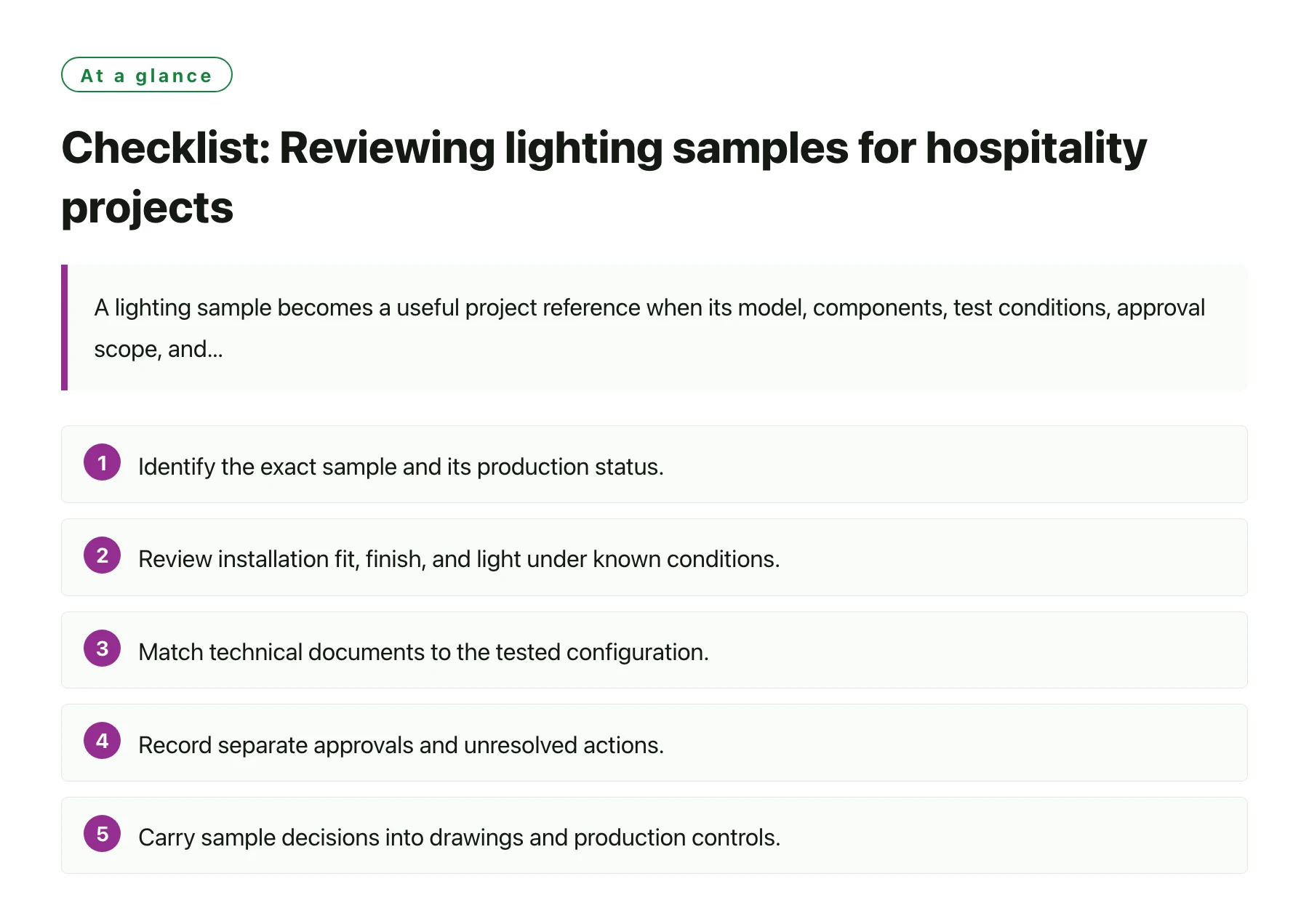
Key takeaways
- Identify the exact sample and its production status.
- Review installation fit, finish, and light under known conditions.
- Match technical documents to the tested configuration.
- Record separate approvals and unresolved actions.
- Carry sample decisions into drawings and production controls.
Sample approval can affect design, construction, electrical coordination, and purchasing. A shared register keeps those decisions traceable.
1. Identify the exact sample
Label each sample with project, room type, fixture code, supplier, model, revision, date, and component set. Confirm whether it is a catalogue sample, engineering prototype, or production-intent unit. A sample only represents the configuration that is recorded; a visually similar unit with a different driver or optic may perform differently.
Keep the sample request tied to a controlled fixture schedule and drawing. Note the intended installation, ceiling or wall condition, voltage, control system, finish, and target light effect. If the sample is incomplete, list missing components and avoid treating the partial assembly as final approval.
2. Check fit, scale, and installation details
Compare outer dimensions, cut-out, recess depth, mounting brackets, weight, cable exit, connector, and service clearance with the drawings and site conditions. Check whether the fixture can pass through the access route and whether a maintenance worker can reach the driver or replaceable parts after installation.
Test installation on a representative substrate or mock-up when fit is uncertain. Record tools and mounting method, not just final appearance. Identify adjacent trades, ceiling structure, trim, and access panels that affect the assembly. Send dimensional changes back through the drawing approval route.
3. Review finish and workmanship
Examine coating uniformity, color, texture, edge quality, seams, screw alignment, lens clarity, diffuser fit, labels, and visible marks under consistent lighting. Compare samples side by side where multiple suppliers or finishes are under review. Note viewing distance and ambient conditions if appearance is a central decision.
Agree acceptable variation before mass production. A sample may be hand-finished and not reflect routine output, so ask how color or surface consistency will be checked across lots. Preserve the approved sample or dated images, and define who may authorize any finish substitution or process change.
4. Evaluate the light output under stated conditions
Record the power source, dimming level, warm-up period, room surface, distance, orientation, and control setting used during evaluation. Review output, beam shape, glare, shadows, color appearance, dimming transitions, flicker observations, and noise where relevant. Do not compare fixtures tested under materially different conditions.
Request photometric files or laboratory data that identify the tested model and configuration. Use a lighting designer to assess whether the result suits the room’s task and design intent. A small sample cannot always represent a full-scale space, so plan a room mock-up when distribution or reflected color could change the decision.
5. Verify driver, controls, and interfaces
Confirm driver make and model, input range, wiring, grounding, dimming protocol, emergency function, sensor behavior, and control response. Test with the project’s intended dimmer or control equipment where compatibility matters. Record any visible flicker, delay, abrupt step, or loss of function and send it to the electrical reviewer.
For connected fixtures, note setup, firmware, network requirements, configuration files, account access, update method, and recurring subscriptions. Ask what happens when internet service is unavailable or a platform changes. Route data, privacy, and IT questions to the relevant project owner instead of relying on a simple product demo.
6. Check safety and technical documents
IEC 60598-1:2024 provides general requirements and tests for luminaires. The applicable product-specific parts and destination-market rules may add requirements; a qualified compliance owner should determine which apply to the exact product. [1]
Match certificates, reports, declarations, labels, and test data to the sample’s model and components. Record issuer, date, scope, and limitations. If the documents cover a different driver, finish, or fixture family, request confirmation or updated evidence before approval. A sample review is not a regulatory assessment.
7. Review packaging and identification
Check that the sample includes expected mounting accessories, connectors, instructions, labels, and protective materials. Record carton dimensions and the packing method if shipping damage or project receiving matters. Verify that fixture and accessory codes match the schedule and that the installer can distinguish similar versions.
Ask how production cartons will identify project, location, item code, finish, and revision. Confirm packing lists and spare units for phased projects. If the sample packaging is not production representative, request a packing mock-up and define how it will be approved before shipment.
8. Record approval status and open items
Use a sample register with status such as approved, conditional, revise, or rejected. List each requirement checked, observation, evidence, approver, date, and open action. A conditional approval should state exactly what must change and what evidence will close it. Avoid relying on a color swatch or verbal comment detached from the fixture identity.
Keep designer, electrical, procurement, compliance, and operations approvals distinct when they cover different decisions. If one owner approves appearance, do not imply the same approval confirms electrical compatibility or safety documentation. Store the final signed record with the controlled drawing and supplier quote.
9. Turn sample comments into production controls
Translate important comments into drawing notes, limit samples, inspection criteria, or supplier process instructions. Identify who checks the requirement in production and whether the evidence is visual, measured, electrical, or document-based. This helps prevent a sample decision from disappearing when the supplier starts a new batch.
Require the factory to identify substitutions and deviations before production. If the approved sample is changed, request a new sample or objective evidence appropriate to the change. Keep old and new revisions clearly separated so the inspector and site team do not compare against an obsolete reference.
10. Make the sample useful to the project team
Share the approved sample record with design, purchasing, inspection, freight, and installation teams. Include handling notes and the contact for unresolved technical questions. For a mock-up, capture room location, fixture layout, control scene, photographs, and the parties present so later review can reproduce the conditions.
Teams comparing Learn more can use this checklist to keep sample identity, design evaluation, technical evidence, and production approval connected. Have the project designer and qualified electrical or compliance reviewer sign off on their respective requirements before the approved fixture becomes the order baseline.
Sources
Frequently asked questions
Who should approve a hotel lighting sample?
Assign separate approval owners for appearance, dimensions, electrical compatibility, documentation, and commercial release as needed.
Can I approve a lighting sample from photographs?
Photos help document visible features, but they cannot reliably establish fit, light distribution, control behavior, or all safety details.
What should be recorded when testing a sample?
Capture identity, revision, setup, power and control conditions, observations, measurements, evidence, open issues, and approver.
Does sample approval cover future production changes?
No. Require notice and review of substitutions or revisions and carry approved criteria into routine production checks.