Birch Panels for European Furniture Manufacturing: Grades and Machining
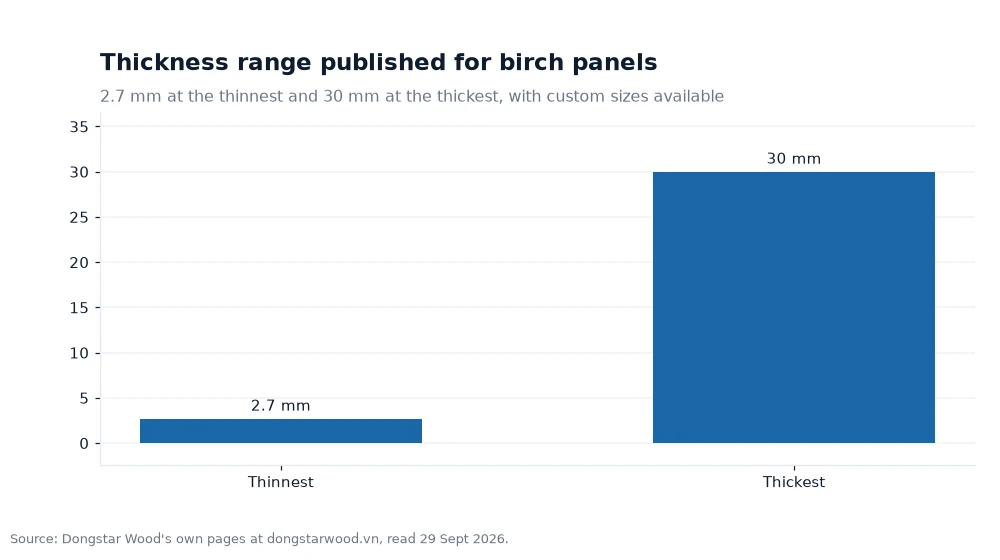
Birch panels are specified for one reason above all others: the face is uniform enough to stain, laminate or paint without a repair line appearing under the lacquer. The published range covers 2.7 mm to 30 mm, four face grades and three standard sizes, which is enough to build a whole furniture programme from a single species.

Key takeaways
- Four face grades are described for birch panels, from A-grade with minor knots and burls to a repaired-defect grade sold on machining reliability.
- Thickness runs from 2.7 mm to 30 mm, so a catalogue can move from drawer bottoms to worktops without changing species.
- Compliance options include E1, CARB P2 and CE documentation — useful when the same carcass ships to North America and Europe.
- The build targets four shop operations — cutting, CNC work, sanding and edge processing — with tear-out held to a minimum.
Why the face grade is a production decision
A face grade is a promise about what your finishing department will find. A-grade birch is described as outstanding condition with some knots and burls allowed, which means a clear panel that still reads as timber. B-grade allows more and larger burls and knots plus colour variation, and C-grade is smooth and sound while showing more variation again. The fourth option is the repaired-defect grade: free of open defects, and honest about repairs.
Match the grade to where the panel is seen rather than to what the mill can supply. A panel facing a drawer runner does not need an A-grade face; a visible door front does, because the alternative is sanding, filling and a second coat of lacquer on every unit.
Sourcing at this level is mostly a documentation exercise. A Birch Plywood Supplier working from its own veneer supply can put grade, glue class and packing on one sheet of paper, and that sheet is what your purchasing file will be checked against a year later.
What the birch veneer does for finishing
The birch veneer face is light cream to pale brown and notably uniform, which is what makes staining and clear sealing predictable. Multi-layer hardwood construction underneath keeps the panel flat during machining, and controlled moisture content plus tight panel tolerance are what stop a door from moving after installation in a heated building. European climates punish panels that arrive at the wrong moisture content, and the failure usually appears a season later rather than on the loading dock.
Where a lacquer or laminate will be applied, ask for a test panel from the batch you are buying. Two or three sheets sprayed in your own booth tell you more about grain raise and blotching than any specification sheet can.
Edge treatment belongs in the same test. Birch takes a banded or solid edge neatly, and a light face makes a poorly fitted edge visible immediately, which is useful when the component will be inspected by a customer rather than by a quality sheet. Run one sample through the full sequence — cut, band, sand, finish — before the batch is released to the line.
| Item | Option | Practical effect |
|---|---|---|
| Face grade | A-grade | Outstanding condition, minor knots and burls allowed |
| Face grade | B-grade | More and larger burls, some colour variation |
| Face grade | C-grade | Smooth and sound with additional variation |
| Face grade | Repaired defects | Free of open defects, may carry repaired areas |
| Thickness | 2.7 mm to 30 mm | Covers drawer bottoms through to thick worktops |
Machining: where tear-out is decided
Tear-out is a question of veneer adhesion and core lay-up rather than blade sharpness alone. The build is aimed at four shop operations — cutting, CNC work, sanding and edge processing — with minimal tear-out, so a router leaves a clean shoulder on the first pass. That matters most on shaped components, where an operator cannot sand the damage away without changing the profile.
Test the four operations on one sheet before committing to a run: rip cut to finished size, profile a curved edge, sand the face, and band an edge. Record the results. A short written record of tool settings that worked becomes the standard for the whole programme, and it survives staff changes.
Worked example: how many sheets fit a stack
Thickness drives storage space. As an example, a one-metre stack of 2.7 mm panels is 1000 ÷ 2.7 ≈ 370 sheets, while the same stack of 30 mm panels is 1,000 ÷ 30 ≈ 33 sheets. Two orders of identical panel area therefore take up more than ten times as much floor space in the thin version, which is why drawer-bottom stock is usually stored vertically.
Panel area follows the standard formats, as an example: 1250 mm × 2500 mm = 3.125 m², and a run of 500 sheets is 500 × 3.125 = 1,562.5 m². Set that against your weekly consumption and you have a simple cover figure for planning veneer orders alongside the panel order.
Compliance and packing for export
The published compliance options are E1, CARB P2 and CE documentation, all supported by low-emission glue systems. For a furniture maker selling into both North America and Europe, a single panel specification that carries the emission and construction paperwork for both markets is worth more than a marginal price advantage.
For shipment the panels travel to export standard: protective wrapping, steel strapping over wooden pallets, with custom packing and labelling offered on larger programmes. If your warehouse receives pallets by forklift and stores them for weeks, agree the wrapping and the stacking limit before the first shipment rather than after the first damaged corner.
Moisture, climate and the European warehouse
Panels that arrive balanced stay balanced. The stated engineering includes moisture control and panel tolerance for European climates, which matters because a heated showroom and an unheated loading bay pull a panel in opposite directions. Let a delivery acclimatise in the workshop for several days before machining, with the sheets stacked flat and separated by stickers so air reaches both faces.
Where a component will live in a kitchen or bathroom, decide the adhesive before the panel: phenolic or melamine options are named for wetter service, and choosing late usually means re-cutting rather than re-ordering. For the rest of the range, E1 or CARB P2 glue keeps indoor air quality arguments short with retail customers.
Frequently asked questions
Do I need A-grade faces for painted furniture?
Not for every panel. Painting hides small colour variation, so B-grade or the repaired-defect grade will usually finish cleanly on parts that are painted after assembly. Keep A-grade for visible natural-finish faces, where knots and repairs would show through a clear coat.
Is birch suitable for marine interiors?
Birch panels are listed for marine use among their applications, and the range offers phenolic or melamine adhesive options for wetter environments. Confirm the glue class against the exposure the component will actually see before ordering, since interior cabinetry behaves differently from a deck component.
How are custom sizes handled?
Standard formats run from 1220 × 2440 mm through 1250 × 2500 mm and 1250 × 3000 mm, and custom sizes are available. Send the cutting list with the enquiry so the mill can confirm which panels come from standard stock and which need a separate schedule.
Building a birch programme
Start from the visible parts of the product and work inwards. The okoume panel options are worth a look where a warmer, pink-toned face suits a design, and the factory background is the quickest route to the plant figures and certification list a purchasing file needs.
Grade, thickness and machining details above are drawn from the manufacturer's own pages, as checked on 29 September 2026 and carried into this article and carried into this article as the source for this guide[1].